The ADHD productivity audit: how to test if your system is actually working (in 2 weeks)
You read an ADHD productivity article. You try the technique for three days. You don't feel obviously better. So you stop, conclude it "didn't work," and move on. A month later you read another article. Repeat. You've now tried twenty strategies and have no idea which (if any) actually helps the version of you that exists in the real world.
This is the central problem with most ADHD self-help: it's unfalsifiable. There's no clear "did this help me" check. So everything gets the same vague verdict — and you end up trusting whichever influencer was loudest, not whichever system actually fits your brain.
The fix is borrowed from clinical research: the N-of-1 trial. One person, one outcome, one structured comparison. Below is a 2-week version you can run yourself. By the end of it, you'll know — with data, not vibes — whether the strategy you're testing is doing anything for you.
Why this matters more for ADHD than anyone else
Neurotypical brains can usually feel a productivity gain. ADHD brains often can't. Time blindness means you lose the felt sense of how a normal day even goes. Delay discounting means immediate friction (the experiment feels annoying) outweighs the long-term payoff (knowing what works). So intuition isn't reliable. External data is.
There's a second reason. The same strategy that helps one ADHD adult lands as noise — or makes things worse — for another. Variability between ADHD presentations is huge. Pomodoro saves person A's life and breaks person B's flow. There is no universal answer. A 2-week audit gives you your answer.
The three metrics that matter
Pick these three. Don't substitute. Don't add five more. The whole point is that the audit must be easy enough that you'll actually finish it on day 14 — not perfect.
Track only these 3 numbers
1. Lateness in minutes (per session)
For each timed task: actual duration minus your estimate. Positive = ran over. Negative = finished early. ADHD adults consistently under-estimate by 20–40% — this number is a direct measure of estimation accuracy.
Example. You estimate "answer emails — 20 minutes." It actually takes 38. Lateness = +18 min. Five sessions later, an average of +14 means your estimates are systemically short. The fix isn't trying harder; it's adjusting the estimate.
2. Completion rate (per day)
Of the items you intended to do today, how many did you actually finish? Ignore items you didn't intend to start. Intentions matter, not aspirations.
Example. Day 1: 4 of 6 → 67%. Day 2: 3 of 5 → 60%. Don't count "wash dishes" if it wasn't on the plan at 9am. The audit isn't about making you look productive — it's about measuring the gap between what you committed to and what you did.
3. Overwhelm rating (1–5, post-session)
Right after a focused work block, rate how overwhelmed you felt during it. 1 = calm. 5 = swamped. This single number is the most predictive ADHD outcome metric there is — overwhelm correlates with task abandonment, evening crash-out, and the next morning's avoidance.
Example. "Write project proposal — overwhelm 4." Three sessions later all rated 4 or 5 → that task needs to be broken down. Initiation paralysis often shows up as high overwhelm before the work starts.
The audit, day by day
Your 2-week audit
Baseline
Change nothing. Just measure your normal week.
Intervention
Change ONE thing. Keep everything else the same.
↓
Days 1–7: Baseline week (no intervention)
Live normally. Don't try anything new. The point is to capture how your current week actually looks — not a curated best-week-ever. Skip a day? Mark it skipped. Miss a rating? Move on.
Track:
- Every timed task → estimate, actual, lateness (in min)
- Each evening → completion rate (done / intended)
- After each focus block → overwhelm 1–5
By day 7 you'll have something most ADHD adults have never had: a measured snapshot of a normal week. The numbers will probably surprise you. People consistently think they're less productive than they are — until they see the data.
Days 8–14: Intervention week (one change only)
Pick exactly ONE strategy to test. Just one. If you change three things at once, you can't tell which one helped. Good candidates:
- Backward planning — start from the deadline, work backwards. (Read the guide.)
- Visual countdown timers for every task ≥ 10 minutes.
- Task breakdown to 4–6 micro-steps before starting anything that scares you.
- Externalization — every captured task off your head, into one inbox. (More here.)
- Movement anchors — one 5–10 min walk or stretch break between work blocks.
Keep everything else identical. Same sleep, same caffeine, same environment if you can. Track the same three numbers.
How to read your results
On day 15, line up the two weeks:
Read your results
- Lateness improved (closer to zero, or trended toward it)? The intervention is helping with estimation accuracy. Keep it.
- Completion rate up by 10%+? Real signal. Keep going.
- Overwhelm down by 0.5 points or more on average? Subjective wellbeing matters most. Even small changes here compound.
- No change? The strategy isn't right for you. That's a valid result — not a failure. Move to the next experiment.
- Got worse? Also useful information. Drop it without guilt.
Two weeks isn't a definitive trial. But it's your evidence — and your evidence beats generic advice every time.
A worked example
Person. Adult ADHD, software developer, chronically over-running task estimates.
Baseline week (no intervention).
- Avg lateness: +24 min per task
- Completion rate: 52%
- Avg overwhelm: 3.4 / 5
Intervention. Backward planning every task ≥ 30 minutes.
Intervention week.
- Avg lateness: +9 min per task (dropped 15 min)
- Completion rate: 71% (up 19 points)
- Avg overwhelm: 2.7 / 5 (down 0.7)
Verdict. Backward planning meaningfully helps this person. Worth making permanent. The same audit on a different ADHD adult might come back flat — also a valid answer. The point is knowing instead of guessing.
The shame trap to avoid
Don't run this audit during a week you already know will be unusual — moving house, illness, a big trip. And critically: don't use bad audit weeks as evidence you're broken. A bad-numbers week is data about that week, not about you.
The audit is a thermometer, not a verdict. If overwhelm is 4.5 every day for two weeks, the message isn't "you're failing." It's "your current workload, environment, or strategy is mismatched — change something." High-overwhelm weeks are signal, not shame.
Why most ADHD apps can't help you do this
To run this audit by hand, you need to manually log: estimate, actual, completion, overwhelm — every day, for two weeks. That's a lot of friction. ADHD brains will abandon it by day 4.
The realistic options are:
- Spreadsheet. Works if you'll actually maintain it. Most people won't.
- Paper journal. Works for some. Has the same maintenance problem.
- An app that captures the data automatically. Far higher chance of completion.
How TimeNinja runs the audit for you
TimeNinja is built around the audit by default. Every feature you'd hand-track is captured automatically:
- Lateness — every timer logs estimate vs actual into your Real Time Library. You don't write it down; the app does.
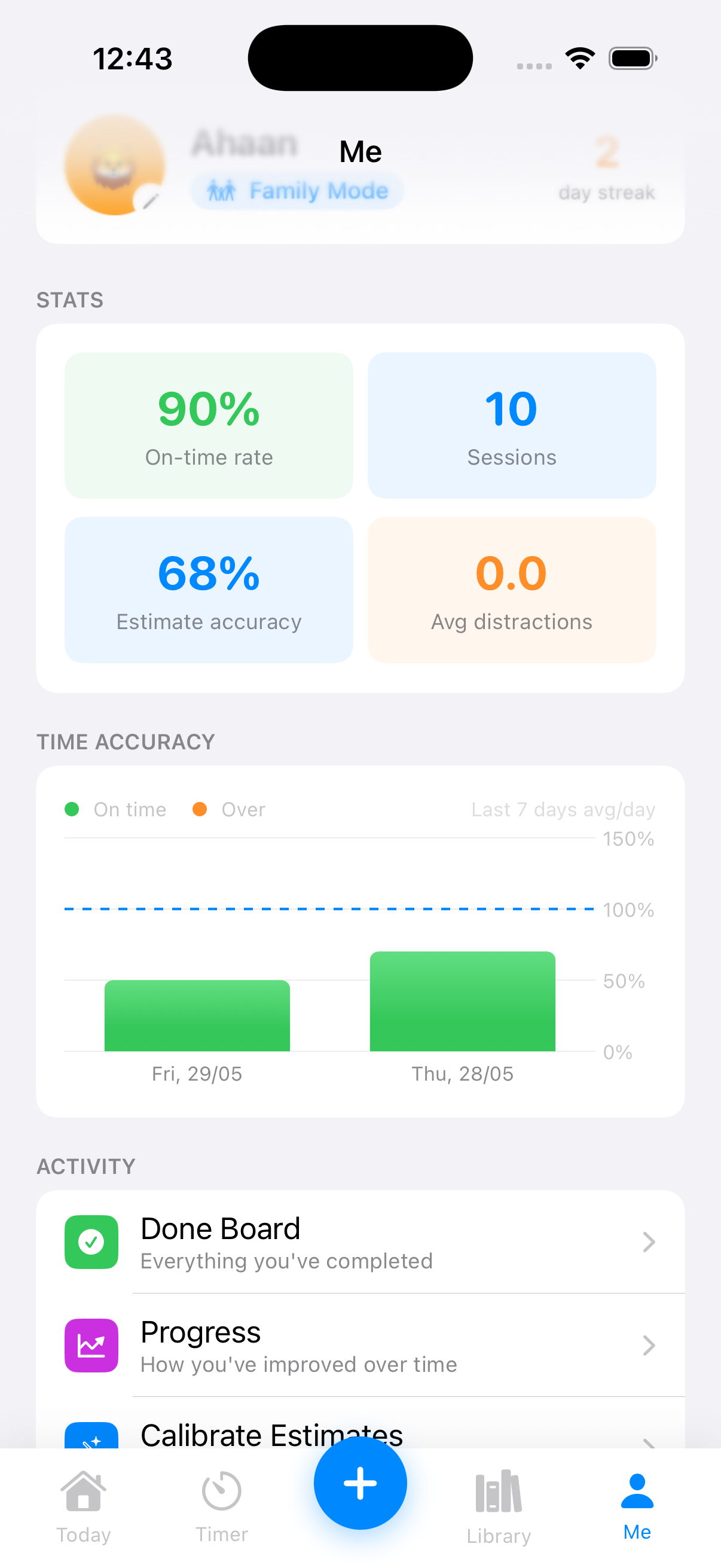
- Completion rate — your Done Board counts intended vs finished, daily.
- Overwhelm rating — a single 1–5 tap appears after every timer completes. Skip it any time without penalty. Stored alongside the session.
- The audit view — Me → Progress shows a 6-week overwhelm trend, a weekly lateness bar chart, and a with vs without backward planning comparison built from your own data. No leaderboards, no rankings. Your numbers, your trend.
- Calibrate Estimates — when your real timings consistently differ from your routine step estimates by ≥15%, TimeNinja proposes a one-tap update (using the median of your last 10 sessions, not the latest run). The audit becomes a Learn loop instead of a one-off exercise.
Two weeks of using TimeNinja gives you the audit. Three months gives you a personal map of what helps your specific brain — and what was someone else's advice all along.
The hardest part is the most valuable part
The hardest moment in this audit is day 4 of the baseline week. You'll be tempted to "just try backward planning early." Don't. The baseline is the comparison. Without it, the intervention week proves nothing.
If you can hold the line for seven days of just measuring, you'll have something rare and useful: a real before-picture of yourself. Almost no ADHD adult has one. After 25 years of being told "just be more disciplined," seeing your real numbers in your real life — and watching them respond to a specific change — is genuinely powerful.
This is also why the audit pairs naturally with the rest of the TimeNinja method. Capture → Plan → Execute → Learn is the daily loop; the audit is the weekly mirror that shows whether the loop is fitting your brain.
The bottom line
Most ADHD productivity content is one-size-fits-all and unfalsifiable. The audit reverses both: it's your data, and there's a clear pass/fail at the end. Run it once and you've broken out of the cycle of trying random strategies forever. Run it quarterly and you're effectively your own ADHD coach — with evidence.
For a deeper look at the gaps it targets, read our seven executive function strategies for ADHD adults and pick one as your first intervention.