Capture → Plan → Execute → Learn: the four-step ADHD time loop
Most productivity advice assumes you can hold a plan in your head, sense time as it passes, and feel future consequences strongly enough to act now. ADHD brains struggle with all three. That's not a character flaw — it's neuroscience. The fix isn't trying harder; it's a system that does the holding, sensing, and feeling for you.
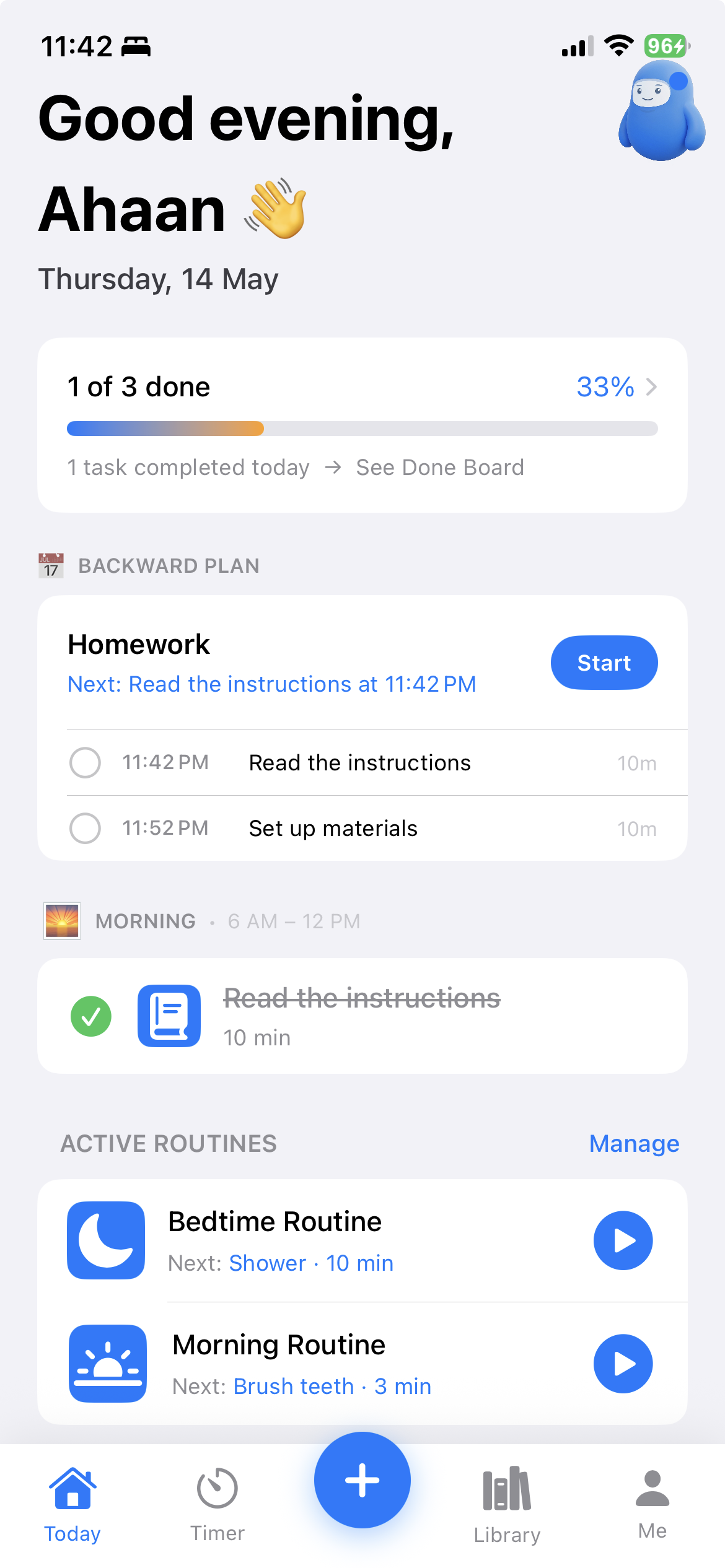
This is the four-step loop TimeNinja is built around. Each step targets a specific executive-function weakness identified in the ADHD research literature.
The full loop in one sentence
Log your intention before the moment passes (Capture), plan backwards from the deadline (Plan), run a visible timer with transition support (Execute), and feed actual durations back into a personal library so next time's plan is realistic (Learn).
Step 1 — Capture: get it out of your head
The problem
Working memory is the most expensive ADHD resource. Anything you "remember to do later" leaks within minutes. That's not laziness — it's a measurable cognitive limit.
What the research says
Cognitive-behavioural therapy for adult ADHD treats externalisation as foundational. The first hour of any CBT-for-ADHD program is typically about getting tasks out of working memory and into a reliable external system. Without this step, every other strategy fails.
What this looks like in practice
- One inbox, one tap. Don't make capture a multi-screen workflow.
- No priorities at capture time. Decisions are expensive. Capture first, decide later.
- Voice memos for moments you can't type. Driving, showering, walking.
- Trust the system. If you don't trust your inbox, your brain keeps trying to remember things "just in case."
TimeNinja's Quick Task button is two taps from any screen. That's intentional. The friction of opening another app, finding the right list, and typing is enough to abandon capture entirely.
Step 2 — Plan: start from the deadline, not now
The problem
Forward planning ("first I'll do this, then that") fails because "now" is fluid for ADHD brains. You drift, the plan dies. Time blindness means the deadline two weeks out feels identical to the one two months out — until it suddenly doesn't.
What the research says
Executive-function models of ADHD emphasise difficulty shifting behaviour from immediate context toward internal representations of future goals. The implication: external systems should anchor planning to a concrete, time-stamped deadline and work backwards from there. This converts an abstract future into a specific present action.
How backward planning works
- Write the deadline. Be specific. Not "Friday" — Friday at 3pm.
- List the steps in reverse order, from the last step (right before deadline) back to the first.
- Sum the step durations. Subtract from the deadline. That's your start time.
- Add 25% buffer. ADHD adults consistently under-estimate task duration by 20–40%.
Read the full backward planning guide →
Why this works
Backward planning collapses three failure modes at once:
- Estimation errors don't compound — the total absorbs them.
- "Start time" becomes a concrete hard moment, not a soft "after lunch."
- A far-away deadline becomes a much closer start time — and "now" is the only time that motivates action.
Step 3 — Execute: make time visible at the point of performance
The problem
You can plan perfectly and still derail at the moment of execution. Hyperfocus eats hours. A "quick" YouTube break stretches to evening. The 25-minute task takes 90.
What the research says
ADHD interventions must work at the point of performance — the moment the person is trying to start, sustain, or finish a task. Generic time-management advice that lives in books, courses, or weekly reviews doesn't transfer to the 11am moment when you're trying to start the report.
Visual activity schedules — pictures and sequences rather than text — are a research-supported intervention for children with ADHD, with promising evidence for improving on-task and on-schedule behaviour. The underlying principle generalises to adults: visible time and visible sequences beat verbal instructions.
What this looks like in TimeNinja
- Shrinking visual ring — the timer is a disc that visibly drains, not just a digital readout. You feel time passing.
- Lock Screen Live Activity — you don't need to open the app to see the timer.
- Step-by-step transitions — when one step ends, the next appears with a clear handoff.
- Off-track support — if you wander, a gentle nudge lets you log what happened and jump back in. No shame loop.
- Apple Watch companion — haptic feedback at milestones means you feel time even with the phone away.
Step 4 — Learn: trust your data over your guesses
The problem
Your gut estimate is unreliable. Always has been. Studies show ADHD adults under-estimate task duration by 20–40%. So plans based on estimates always slip, and slipping erodes self-trust.
What the research says
Timing research in ADHD repeatedly highlights variability as the core issue — not just being slow or fast, but inconsistent. Designing for variability bands (a range, e.g. 25th–75th percentile) instead of single-point estimates is a research-aligned product choice.
How the Real Time Library works
Every TimeNinja session stores your actual duration. After 5–10 sessions of any repeated activity, your personal range appears:
- Usually 12–18 min for "make breakfast" — not the 8 minutes you guessed.
- 25–75% variability band — half your sessions fall in this range. Use this for realistic planning.
- Median, not mean — robust to outliers (one terrible morning doesn't skew the whole picture).
Why your Real Time Library matters →
The loop is the product
Each step exists because the previous one created a need for it:
- Capture exists because working memory leaks.
- Plan exists because captured items without scheduled time don't get done.
- Execute exists because scheduled plans without visible support don't survive the moment.
- Learn exists because plans based on guesses keep failing.
Together they form a closed loop that gets better with use. Most productivity systems stay the same no matter how many times you use them. TimeNinja gets more accurate every week because the Library accumulates your truth.
What's intentionally NOT in the loop
- Priority matrices. Decision fatigue is real. Sort by deadline urgency, not by abstract importance scores.
- Daily reviews. Another ritual to skip. The Library updates automatically.
- Streak shame. Missing a day doesn't break anything. The data still accumulates.
- Notification spam. One nudge before deadline, optional. Not constant pings.
The bottom line
If you've tried a dozen productivity apps and none stuck, it's probably because they all asked you to do the same thing: plan in the morning, execute in the moment, review at night. Three separate cognitive workflows your brain has to bridge — and the bridges always fall apart.
A single closed loop with each step supporting the next is a different shape. It's the shape that fits an ADHD brain.
Want to know whether the loop is actually working for you? Run the 2-week ADHD productivity audit — a structured N-of-1 self-experiment that captures lateness, completion rate, and overwhelm before and after you adopt the loop.
Try the loop in TimeNinja — free 7 days
New to the app? See how to use TimeNinja effectively — the daily habits that run this loop for you.