How a daily AI planner helps ADHD brains
Most "AI productivity" is marketing. Chat with a chatbot about your day, get a generic list, and nothing changes. But there's one place AI is genuinely useful for ADHD brains — and it's not the place most apps put it.
What AI is bad at for ADHD
- Telling you how long things take. It uses general averages. Your brain isn't general.
- "Optimizing" your schedule. The bottleneck isn't optimization — it's starting.
- Daily check-in chatbots. Another task to do. Friction, not relief.
What AI is genuinely great at
One thing: breaking down vague tasks into concrete first steps.
"Write the science report" → ADHD brain stalls. There's no entry point.
AI converts it to:
- Open a blank doc and write the title (2 min)
- Brainstorm 3 main points (10 min)
- Find one source for each point (15 min)
- Write the intro paragraph (15 min)
- Write each main point (60 min)
- Write conclusion (10 min)
Now there's an entry point: "Open a blank doc." That's a "now" task. The activation barrier collapses.
Why this matters for ADHD specifically
The single biggest predictor of whether an ADHD brain starts a task is whether the first step is concrete and small. Research on task initiation shows the time gap between "I should start" and "I started" balloons when the first step is vague.
AI is perfect for the decomposition step because it's tireless, judgement-free, and always available at 11pm on a Tuesday when you're staring at "finish project."
How TimeNinja's AI works
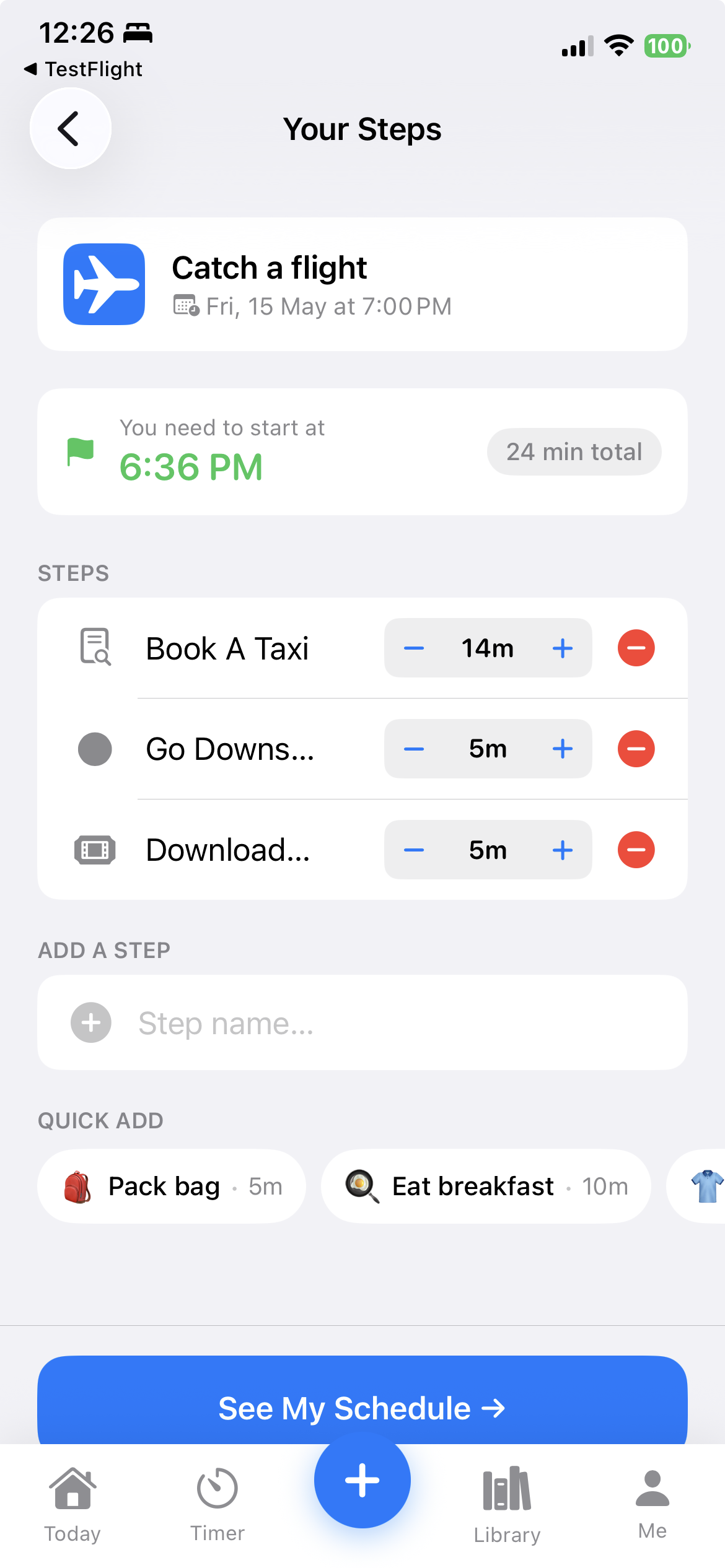
TimeNinja's Break It Down feature does exactly this and nothing more:
- You type the task in plain English.
- AI returns 4–8 concrete steps with rough time estimates.
- Each step becomes a runnable timer with the visual ring.
- Your actual timing gets logged so future plans use your real numbers, not the AI's averages.
We deliberately don't have an AI chatbot. We don't ask you to journal. We don't pretend AI knows you. It just decomposes — fast — when you're stuck.
Tips for using AI breakdown well
- Use it when you're stuck, not as a daily ritual. The friction of "ask AI" defeats the purpose if you have to do it every morning.
- Edit the steps. AI's first attempt is rarely perfect. Tweak the times based on what you know about yourself.
- Trust your real-timing data over AI estimates. Over weeks, the app's variability band will be more accurate than any AI guess.
- Stop after 2 levels. Don't break a 5-min subtask into 6 sub-sub-steps. You'll spend longer planning than doing.
The bottom line
Don't pick a planner because it has "AI." Pick one because the AI does one useful job. For ADHD brains, that job is task decomposition — and almost nothing else.