7 executive function strategies for ADHD adults
"Executive function" is the brain's project manager: planning, prioritizing, starting, sustaining, switching, self-monitoring, and emotional regulation. ADHD doesn't break it — but it makes the cost of using it 5–10× higher. So strategies that "just use willpower" don't scale. These seven do.
1. Externalize, don't memorize
Working memory is the most expensive ADHD resource. Anything held in your head — appointments, intentions, half-formed ideas — leaks. Get everything onto an external system: phone, paper, sticky notes, app. If it's only in your head, it's already lost.
How:
- One inbox app for capture (don't proliferate).
- Voice memos for the moments you can't type.
- Photo-based reminders for physical items.
2. Make time visible
Time blindness is an executive function problem (see our deep-dive). Replace internal time-sensing with external time-showing.
- Visual timers (sand, ring, Time Timer).
- Analog clocks in workspaces.
- Live activities on your phone lock screen.
3. Lower activation energy
The hardest moment is starting. Reduce the friction:
- Lay out tomorrow's clothes tonight.
- Open the doc the night before — leave a half-finished sentence.
- Break tasks down to a first step under 2 minutes.
4. Body-double or external accountability
A second presence (real or virtual) shifts "not now" to "now." This is why coworking apps, study streams, and pair programming work so well for ADHD adults.
- Schedule a 30-min coworking call with a friend.
- Use Focusmate, Caveday, or similar.
- Text someone "starting now" — light external accountability still works.
5. Plan backwards, not forwards
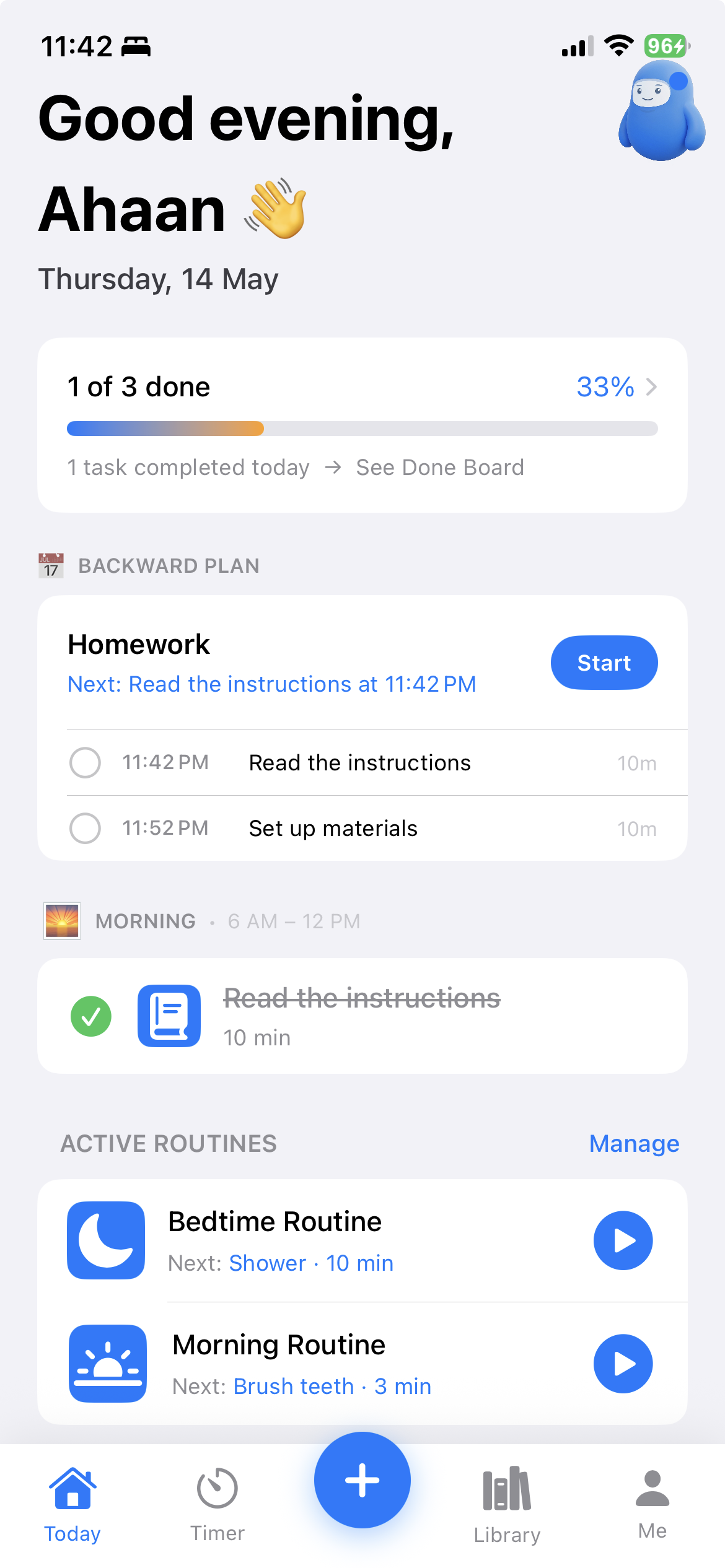
Forward planning collapses because "now" is fuzzy. Backward planning from a deadline creates a hard start moment. Full guide here.
6. Track real timing, not gut estimates
Your estimates are unreliable. Your data isn't. After 5–10 sessions of any task, you'll know the truth — and can plan with realism instead of optimism.
Apps like TimeNinja show your 25–75% variability band automatically; or just log times in a spreadsheet for two weeks.
7. Build for the bad days
Don't design systems for your best self. Design for the version of you who slept badly, skipped meds, or is overwhelmed. If a system only works on a perfect day, it'll fail you on the 80% of days that aren't.
Test: "Will I still do this when I'm tired and demotivated?" If no, simplify.
The unifying principle
Every effective ADHD strategy follows one rule: move the cognitive load out of your head and into your environment. The brain that struggles with executive function shouldn't be forced to run the executive function. The environment should.
How to know if these strategies actually work for you
Seven strategies is a menu, not a prescription. ADHD presentations differ enough that one of these will be life-changing for you and another will be irrelevant — and there's no way to know in advance which is which. Pick one and run our 2-week ADHD productivity audit: it tracks lateness, completion rate, and overwhelm so you can see, with data, whether the strategy is doing anything.