N-of-1: the most honest way to find what actually works for your ADHD
You've read the same productivity article a dozen times. Time-blocking. Pomodoro. Bullet journals. Cold showers. Apps. Books. Each one swears it's the answer. Each one works for a week, then quietly stops, and you assume you're the problem.
You're not. The problem is that generic advice can't tell you what works for you — only data from your own life can. That's what an N-of-1 trial is for.
What is N-of-1?
In medical research, "N" is the number of participants in a study. N-of-1 means a single-person trial — you are both the researcher and the subject. You pick one variable, measure outcomes before and after introducing it, and decide based on your own data whether to keep it.
For ADHD this matters more than for almost any other condition. Why:
- ADHD presentations vary wildly. Pomodoro saves person A; it breaks person B's flow. There's no universal answer.
- Time blindness fakes the signal. You think a strategy "didn't work" after three days because you can't feel time accumulating; the data would tell a different story.
- Delay discounting fakes the verdict. Immediate friction (the strategy is annoying) outweighs the long-term payoff (it actually helped). Without a record, you'll abandon the right things for the wrong reasons.
N-of-1 sidesteps all three problems by writing down what actually happened.
Why this is more rigorous than it sounds
"Tracking yourself" feels squishy compared to a randomised controlled trial. It isn't. Within-subject comparisons (the same person, week A vs week B) actually remove the biggest source of noise in cross-person studies: individual variation. Clinical researchers run N-of-1 trials for chronic conditions exactly because the patient-to-patient differences are so large that averaging across people hides the truth for any single person.
For your own life, that "noise" is everything that makes you not the average ADHD person. Sleep patterns, medication, work environment, season, hormones. An N-of-1 controls for all of it because you're the same person across both weeks.
The minimum viable audit (paper + phone clock)
You can run a useful N-of-1 with three things: a piece of paper, your phone's clock app, and 30 seconds at the end of each work block. Here's the bare protocol.
Pick three metrics. Just three.
- Lateness (minutes). For each timed task: actual duration minus your estimate. Positive = ran over, negative = early.
- Completion rate (%). At the end of the day: items you intended this morning ÷ items finished.
- Overwhelm (1–5). Right after a work block, write a single number. 1 = calm, 5 = swamped.
Don't add a fourth. The whole point is the audit has to be easy enough to finish.
Week 1 — Baseline (no intervention)
Live normally. Don't try anything new. Don't be on your best behaviour. The goal is to capture how your week actually looks, not how a curated version of you would look.
Each timed task: write down the task, your estimate (in minutes), and the actual time when you finish. Each evening: write the completion rate. After each focus block: write the 1–5.
By Sunday you have a normal-week snapshot. Most ADHD adults have never had one. The numbers will probably surprise you — usually you'll find you're doing more than you felt like you did.
Week 2 — Intervention (one change only)
Pick ONE thing to test. Just one. Common candidates:
- Backward planning (start from deadline, work back) — see our guide.
- A visual timer for every task ≥ 10 minutes.
- Externalising everything to one inbox — see externalisation.
- A 5-min movement break between work blocks.
- Breaking every big task into 4–6 micro-steps before starting.
Apply ONLY that change. Keep everything else identical — same sleep, same caffeine, same environment if possible. Track the same three numbers.
Read your results
On day 15, line up the two weeks. Three honest questions:
- Did lateness trend toward zero? → Better estimation = real progress.
- Did completion rate rise by 10% or more? → Real signal, keep it.
- Did overwhelm drop by 0.5 points on average? → Subjective wellbeing matters most. Even small drops compound over months.
If the answers are mostly yes, the strategy is helping you. Keep it. If mostly no, it isn't — for you. Drop it without guilt and try the next one.
The shame trap to avoid
Don't run this during a week you already know will be unusual — moving house, illness, a trip. And critically: a bad-numbers week is data about that week, not about you. High overwhelm for 14 days straight isn't proof you're broken — it's evidence your current workload, environment, or strategy is mismatched. Change something.
The audit is a thermometer, not a verdict.
Why most apps can't do this for you yet
To run an N-of-1 by hand you have to log estimate, actual, completion, and overwhelm every day for two weeks. That's a lot of friction. Many ADHD brains will abandon it by day 4 — exactly when the data starts mattering.
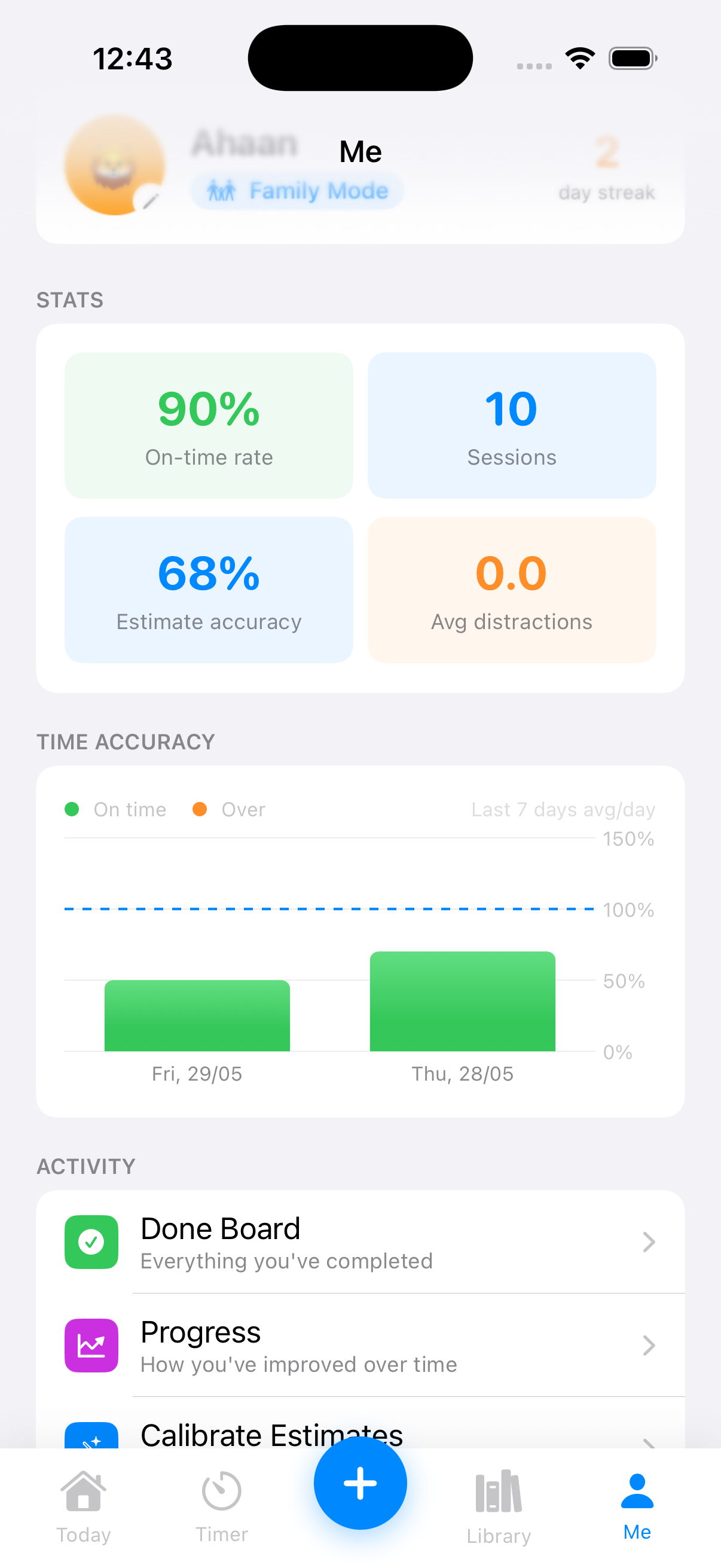
We're building TimeNinja around removing that friction. Every timer auto-logs estimate vs actual into a private Real-Time Library. A one-tap overwhelm rating appears after each session (skippable, no shame). The Progress view in the app shows a weekly trend and a with vs without backward planning comparison built from your own data — the audit happens in the background.
The guided in-app audit wizard (a structured baseline-week → intervention-week walkthrough) is coming in v1.2. Until then, this paper version works — and the methodology is yours either way.
The bottom line
You don't need a randomised controlled trial. You need your data, captured for two weeks, compared honestly. That's enough to break out of the cycle of trying random strategies forever and finally know what helps you.
Pick one strategy. Track three numbers. Two weeks. Then decide.
Try TimeNinja's auto-audit — free 7 days
Related reading
- The ADHD productivity audit — the full 14-day protocol with a worked example.
- Why variability beats averages — how personal timing data turns into self-knowledge.
- What is ADHD time blindness? — why your gut estimates are unreliable in the first place.