Task initiation paralysis: why ADHD brains can't start — and how to break it
The problem
You sit at your desk. The report is due tomorrow. You've thought about it for two days. The doc is open. You stare at the cursor. Half an hour passes. You haven't typed a word — but you also haven't gotten up. You just sit there, knowing exactly what to do, and unable to do it.
This is task initiation paralysis. If you have ADHD, you've lived it hundreds of times. It's the gap between intention and action, and for most people it's a few seconds. For ADHD brains, it can be hours.
Why it's normal in ADHD
Executive-function models of ADHD identify task initiation as one of the seven core deficits, alongside planning, working memory, self-monitoring, emotional regulation, sustained attention, and switching. It's not laziness — it's a measurable difference in how the brain transitions from "thinking about doing" to "doing."
Three mechanisms make starting hard:
- Activation energy. The first action of any task costs a disproportionate amount of mental energy. Once you're moving, momentum carries you. ADHD brains pay a higher activation tax than neurotypical brains.
- Vague first steps. "Write the report" has no concrete entry point. Your brain can't act on an abstract noun. It can act on "open the doc and type the title."
- Delay aversion. When the reward is far away (a future deadline, a future grade), the ADHD brain discounts it steeply. The boring start now feels worse than the panic later.
None of this is willpower. It's neurology.
What doesn't work
- "Just start." If you could, you would have.
- Long todo lists. Add more abstract items, sit longer.
- Shame. Increases the activation cost. Makes the next attempt harder.
- Big-picture planning. You don't need a plan; you need a first physical action.
What actually works
1. The 2-minute rule, reframed for ADHD
Don't think "do the task." Think "do the smallest possible physical action that gets me closer." Not "write the report" — "open the document." Not "clean the kitchen" — "put one dish in the sink." Two minutes max.
Once you've started a 2-minute action, your brain shifts from "thinking" mode to "doing" mode. Momentum becomes possible.
2. Externalise the first step
If the first step is in your head, your brain has to manufacture it under load. If it's already written down (the night before, or by an app), you don't have to decide — you just act. More on externalisation.
Working near another person — body doubling — lowers the same activation cost without any extra willpower.
3. Make the deadline feel present
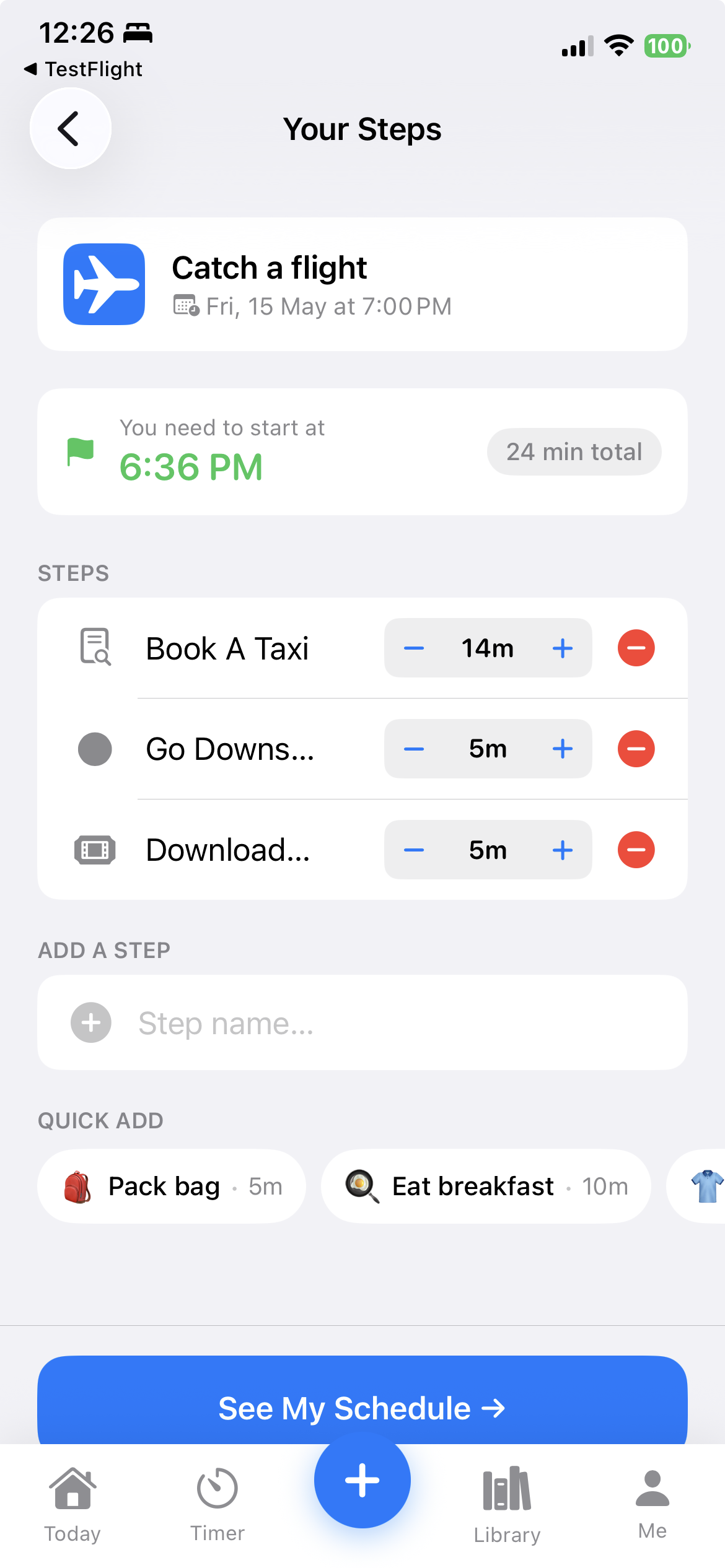
Activation paralysis often happens because the deadline is too far away to motivate. Backward planning from the deadline collapses "this is due in a week" into "I need to start at 6:20pm today" — and 6:20pm has motivational pull that "next week" doesn't.
4. Visible countdown
Once you start, a visible shrinking ring removes the "how long have I been at this?" question. Time becomes felt. The decision to keep going gets easier.
How TimeNinja handles this
The whole app is engineered around the activation problem:
- Break It Down takes "Kitchen cleanup" and returns 4 concrete first steps so you can act on something specific in 30 seconds.
- Backward planning converts vague future deadlines into concrete start times.
- One-tap Quick Task means capture costs less than the friction of starting.
- Visual ring reduces the "I've been at this forever" feeling that triggers abandonment.
You don't need more willpower. You need a system that lowers the activation cost. Read about the full loop.
One experiment for this week
Pick a task you've been avoiding. Don't plan it. Just write down the smallest possible first physical action (under 2 minutes). Do that action. Stop after 2 minutes if you want.
Notice whether you keep going.